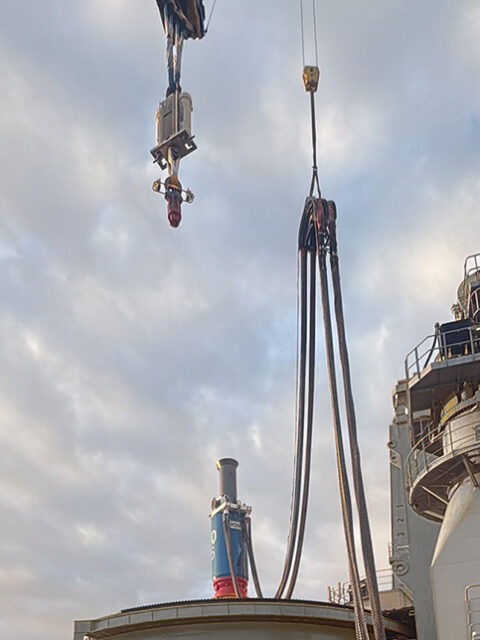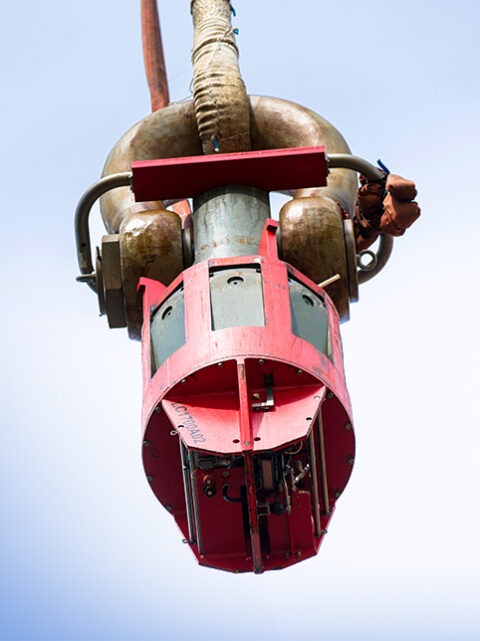
Handling heavy offshore installation tools demands a combination of safety, control, and efficiency. IQIP has been providing a proven and highly reliable method for handling a broad range of installation tools for years. The approach is simple: coupling and lifting via dedicated sockets used in combination with the Combi Lifting Tool (CLT).

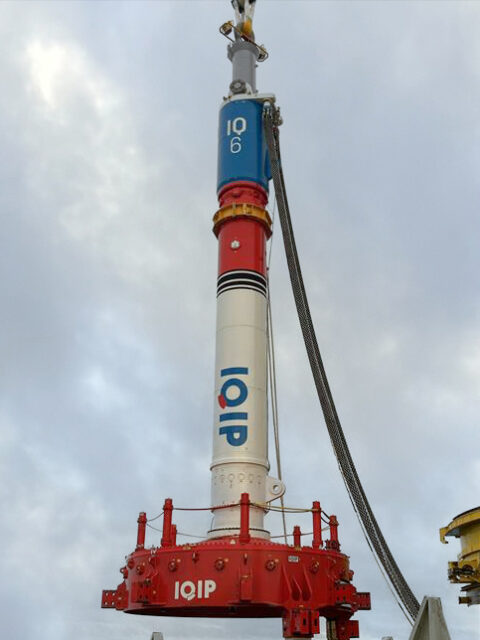
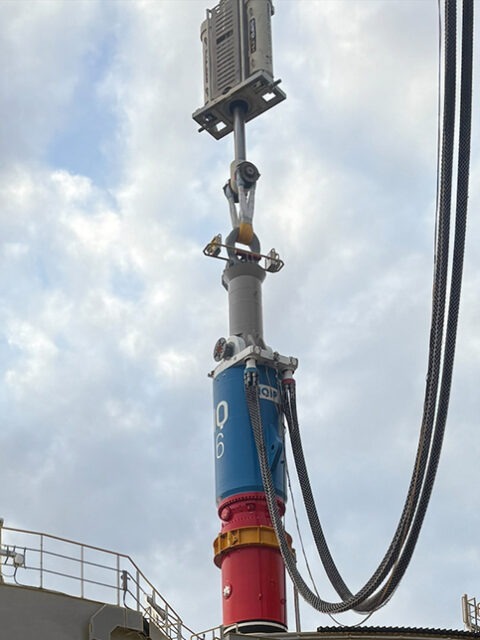
The latest use in the field, involving a Hydrohammer® IQ6 equipped with a hammer socket, has once again shown how effective and advantageous this method is for safe and efficient offshore operations. Equipping the Hydrohammer with a hammer socket creates a dedicated interface that allows the CLT to connect directly with the hammer through its internal connector. Once inserted, a ring of latches expands beneath the socket flange to form a secure mechanical connection. This setup replaces traditional hook and sling configurations, reducing manual handling and increasing safety during deck and crane operations.
WhatsApp Image 2025 12 27 at 12.42.15 cropped
processed 6EB511B7 E6C0 466D A938 79C98F25AFE0 3a
processed 6EB511B7 E6C0 466D A938 79C98F25AFE0 cropped 2
13 DSC06133 bewerkt
Free riding capability

If project‑specific pile driving procedures allow, one of the key advantages of using the hammer socket is the ability to fully disconnect the crane from the hammer before driving begins. This enables free riding, an important safety measure in the event of a pile run.

Free riding with traditional hook‑and‑sling connections is done by slackening the crane wire, but the hammer remains physically attached. In a pile run situation, this connection can transfer sudden dynamic forces to the crane, affecting vessel stability and putting unnecessary stress on equipment.

When driving procedures confirm that free riding is permitted, using a hammer socket avoids these risks. The hammer is completely disconnected from the crane, sudden downward movements are not absorbed by the crane, and nearby assets are protected from shock loads. This results in a reduced‑risk situation during pile run behaviour, improving safety for both crew and assets.

Operational and logistical advantages

Beyond the opportunity for free riding, this method of coupling and lifting offers clear advantages in daily offshore operations:

  • Automatic couplings and lifts using one internal connector across multiple tools with corresponding sockets.
  • Fewer rigging operations on deck, reducing riggers’ exposure to high‑risk areas and lowering deck congestion.
  • Reduced risk associated with manual rigging of hooks, slings and shackles.
  • More autonomous control for the crane operator, supported by integrated GPS, cameras and inclination sensors.
  • Reduced crane movement, resulting in lower wear on wires and sheaves, shorter sling requirements and fewer consumables.

These advantages improve both the pace and predictability of offshore operations.

Reliable, repeatable and ready for use

Connecting and lifting with sockets is a highly effective way to handle Hydrohammers and other installation tools. With just one Combi Lifting Tool (CLT), operators can couple and lift one tool or multiple tools equipped with matching sockets.

The result is a method that consistently delivers higher safety, reduced operational risk, faster turnaround times, lower material usage and increased efficiency.

Contact us to take your lifting operation to the next level.

Curious? Please do not hesitate to contact us!